

From the Banks of the Drina to Tanglin Mall
A Serbian chef in Singapore cooks the memory of two homelands, and has written their tables into a book: The Grand Heritage Cookbook – Tastes of Serbia and Greece
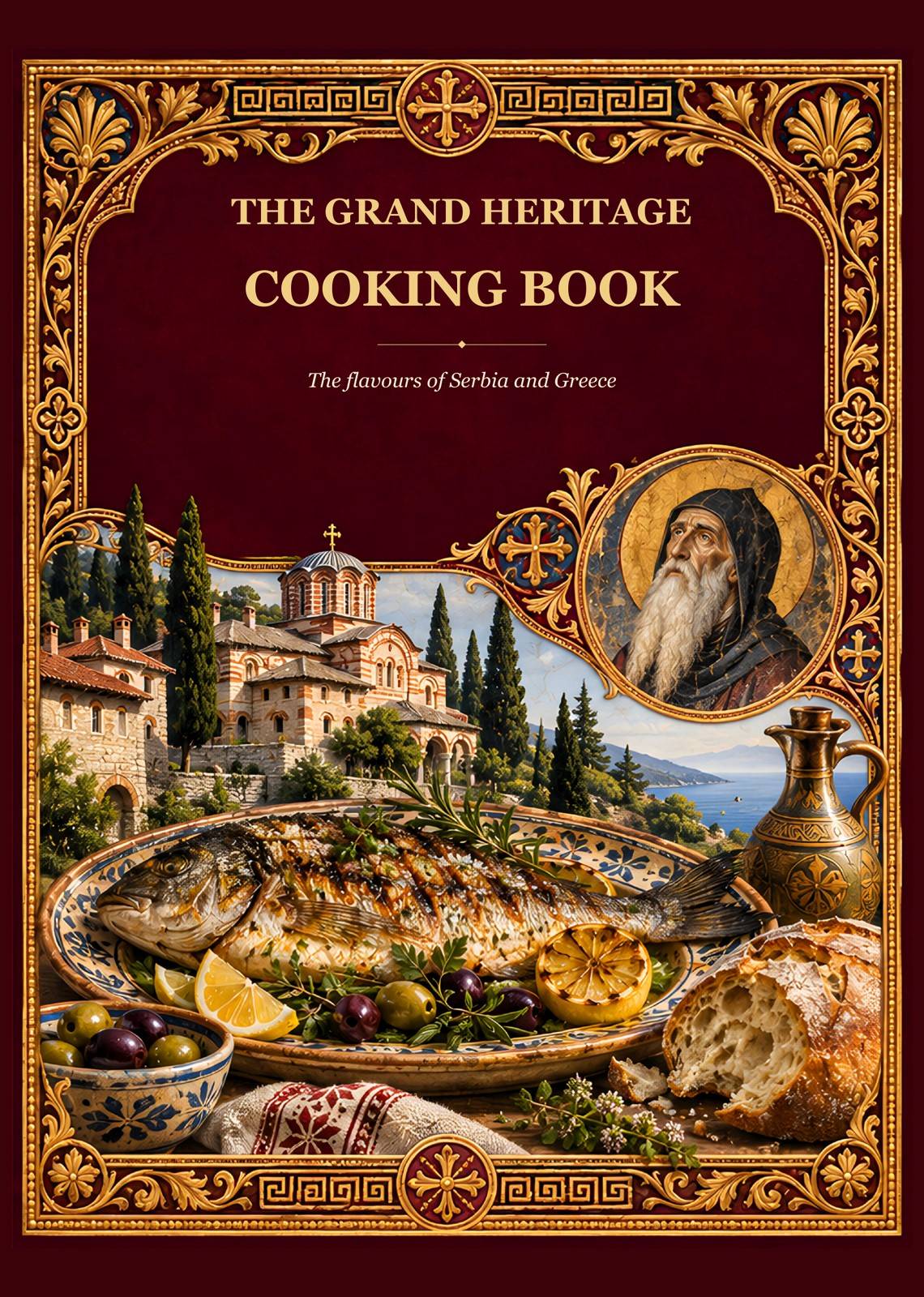
Front cover of the English edition, The Grand Heritage Cookbook – Tastes of Serbia and Greece
(Singapore, November 2026) A Serbian chef in Singapore cooks the memory of two homelands, and has written their tables into a book.
On a humid afternoon in Singapore, in a Greek kitchen at Tanglin Mall, Executive Chef Djordjo Cetkovic does something that belongs to another climate entirely. He makes his own kajmak. Kajmak is the rich, slowly made cream of the Serbian table, the sort of thing a guest meets on warm bread before the rest of the meal has even arrived. It is not a product the tropics offer easily. That, for Cetkovic, is precisely the point. “I make my own kajmak,” he says, “so that the taste of that table does not remain only a memory.”

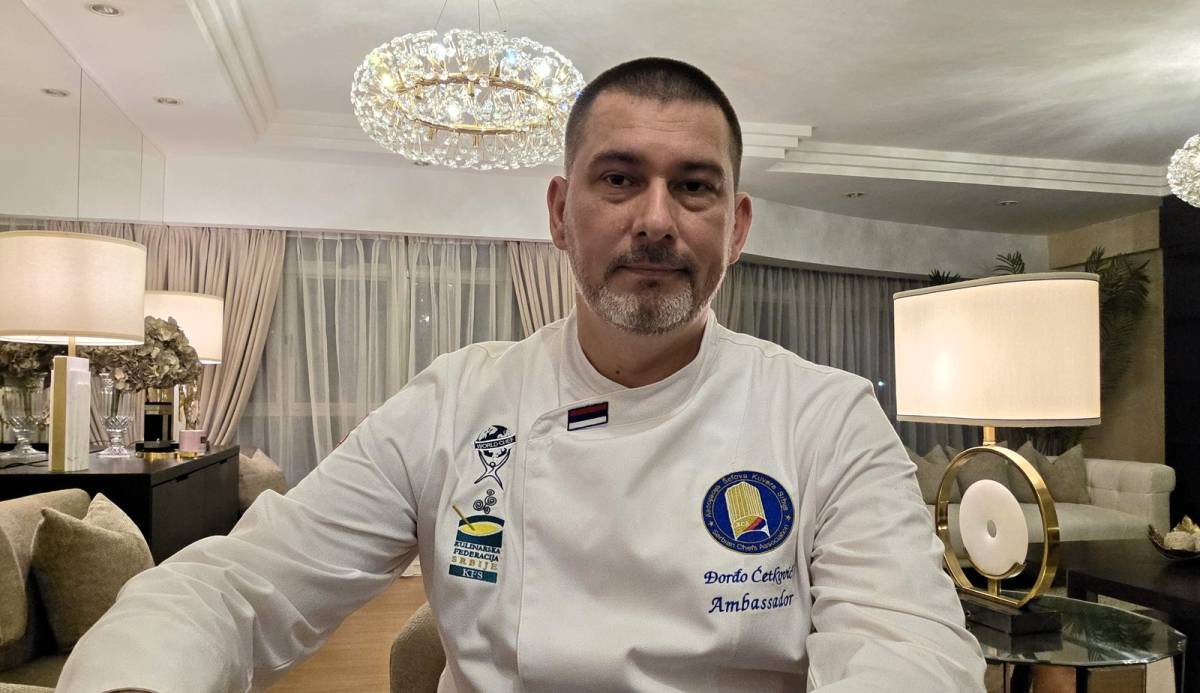
Executive Chef Djordjo Cetkovic in chef’s whites, Singapore, October 2026
The table he means begins a long way from Orchard Road. Cetkovic was born in Tuzla, in Bosnia and Herzegovina in 1983 and grew up in Loznica, on the Serbian bank of the Drina. His mother comes from the other side of the same river. In that valley a guest at the door is welcomed first with bread and salt. Before cheese or kajmak or homemade wine arrives, the host brings a warm loaf; the guest breaks a piece and dips it in salt. “That was my first school,” he says, “long before I put on a chef’s jacket. My mother’s table taught me why we cook. The kitchens that came later taught me how.”
Those kitchens began in 2004, after the secondary school of economics, on the cook’s track, in Požarevac, in what was then Serbia and Montenegro. His first formal school of the craft was in Graz, at Hotel Daniel, under Chef Kristijan Kohner, for whom the kitchen was a way of life: the station clean, the knife sharp, the ingredient respected, the voice at the pass one voice. Switzerland and Germany deepened that discipline. “Precision is a form of respect,” he says, for the product, for the brigade and for the guest. Portugal taught him another restraint: olive oil, the sea and the courage to stop when the ingredient is already enough. “When the fish is good and the oil is good, you do not need to invent a story for the plate.”
Greece brought him closest to the kitchen he leads now. For a year and a half, he cooked on the island of Thasos: lemon, olive oil, the grill, wild herbs and the sea. “I learned how little you need when the product is honest,” he says, “and how much of the cuisine lives in the shared table, not only in the recipe.”

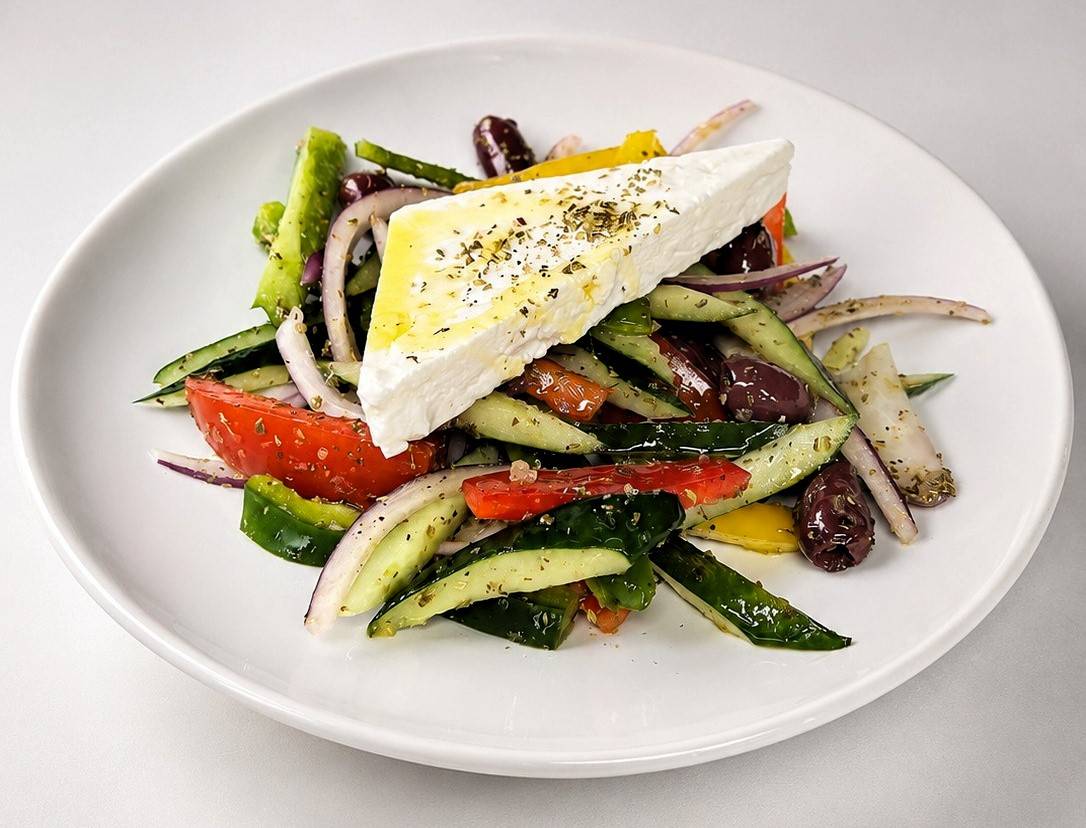
Horiatiki, the Greek village salad, at Pano Kato, Tanglin Mall, Singapore
In 2018 he arrived in Singapore through the Culinary Federation of Serbia, to open Zorba’s for 1Group at Clarke Quay. It was the beginning of a life in this city, not a short posting. He has since worked in nine restaurants here, including a period with The Black Hole Group from 2024 to 2026. On 1 June 2026 he became Executive Chef at Pano Kato, a Greek and Mediterranean restaurant at Tanglin Mall, leading a team of nine.
Singapore taught him to learn again, not how to cook, but how a guest here tastes. Dough behaves differently in this climate. Herbs wilt faster. Dairy needs stricter storage. A European brigade system copied word for word does not breathe in a Singapore kitchen; you have to explain the purpose of a rule, not only give the rule. “Singapore is no longer a posting for me. It is home.” His wife, Masziana, is Singaporean, and he calls her his greatest support.
People sometimes ask how a Serbian chef comes to lead a Greek kitchen. His answer is that the distance between those tables is smaller than the map suggests. Both are built around bread, fire and a guest who is fed first and fed generously. Balkan meze and Eastern Mediterranean mezze are a way of remaining at the table longer than hunger requires. Serbian sarma sits very close to Greek dolmades: a seasoned filling, wrapped in leaves, cooked slowly. Ražnjići, grilled meat on a skewer, understand souvlaki. The names change, the hills change, the oil changes. The idea that a guest should leave the table fuller in more than one sense does not.
That kinship is not a licence to blur the two. “Respect comes first,” he says. “Tradition is not a museum piece. It is a living language, one that can be respected, questioned and expressed with contemporary technique.”

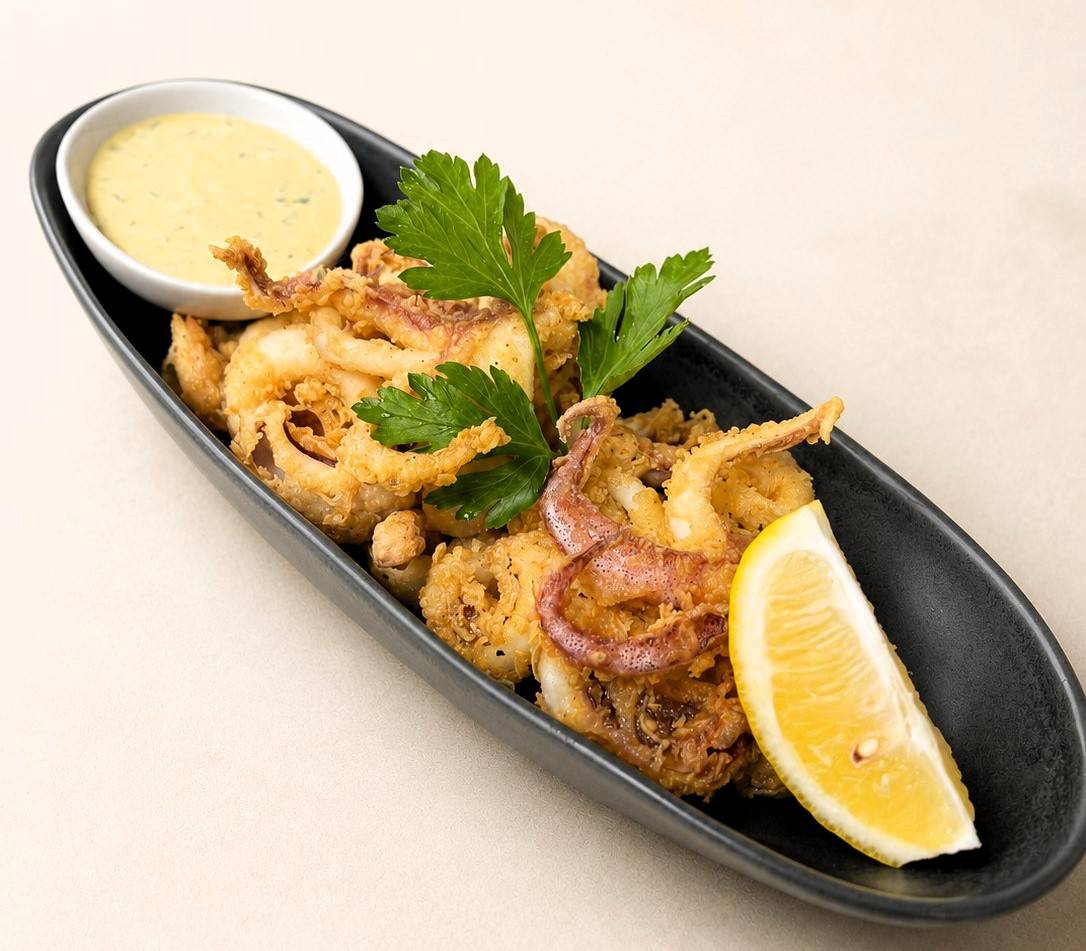
Kalamarakia tiganita, crisp fried squid with lemon, at Pano Kato, Tanglin Mall, Singapore
The same respect runs through the book he has finished for an Asian readership. The Grand Heritage Cookbook – Tastes of Serbia and Greece gathers 145 recipes in five parts: the generous Serbian table; the Lenten table inspired by Hilandar, the Serbian monastery on Mount Athos; historical reconstructions of the table of Stefan Nemanja, the medieval ruler who helped found that monastery; the Hellenic kitchen of olive, grain and sea; and a contemporary fine-dining chapter. The English edition is the one he hopes will travel here. The book is due to appear around 28 November, as Christmas Lent begins, a season when the Serbian table grows quieter, and beans, vegetables, grain, bread and oil have to feed people well. Hilandar matters to him as a school of restraint: when meat, dairy and eggs step back, every remaining ingredient has to work. “A pot of well-made beans,” he likes to say, “has never needed a trend.”
Heritage, in his telling, also changes scale without losing its meaning. At home in Serbia, the family Slava, the annual feast of the household’s patron saint, lasts three days, and some hundred guests pass through the house. In Singapore the same feast becomes a small family table. “Slava is not measured by the number of chairs,” he says. “It is measured by whether you remembered your own people, and whether you opened the door.”
He still opens it. Sometimes what comes through is a plate of horiatiki or kalamarakia at Pano Kato. Sometimes it is kajmak that he has made himself, in a city that did not ask for it and, he finds, is glad to taste it. “You can change the climate, the continent and the language,” he says. “But when you set the table, you cook again as you were taught at home. As my mother cooked.”
The road from the Drina to Tanglin Mall is a long one on a map. On the plate, it is a shorter journey: two generous tables, a river and a sea, and a chef who has decided that home is something you can carry, and share.
About the author: Djordjo Cetkovic is a Serbian Executive Chef and Culinary Ambassador for Asia of the Culinary Federation of Serbia. Since 1 June 2026 he has led the kitchen at Pano Kato, a Greek and Mediterranean restaurant at Tanglin Mall in Singapore. His English-language book, The Grand Heritage Cookbook – Tastes of Serbia and Greece, brings together 145 recipes across five parts and is due to appear around 28 November 2026. https://www.djordjocetkovic.com/

ORDER HERE: fcowanmedia@gmail.com : Or go to Amazon: The Orange Sofa: Unicorn Eyes: Walking Home: Singapore Circuit Breaker. Zero Visibility - The Rescue of the Thai Football Team trapped in the cave in Northern Thailand.